The 1989 Experiment That Proved Our Clocks Run Wrong in Darkness
What Happens to Your Internal Clock Without Sunlight?
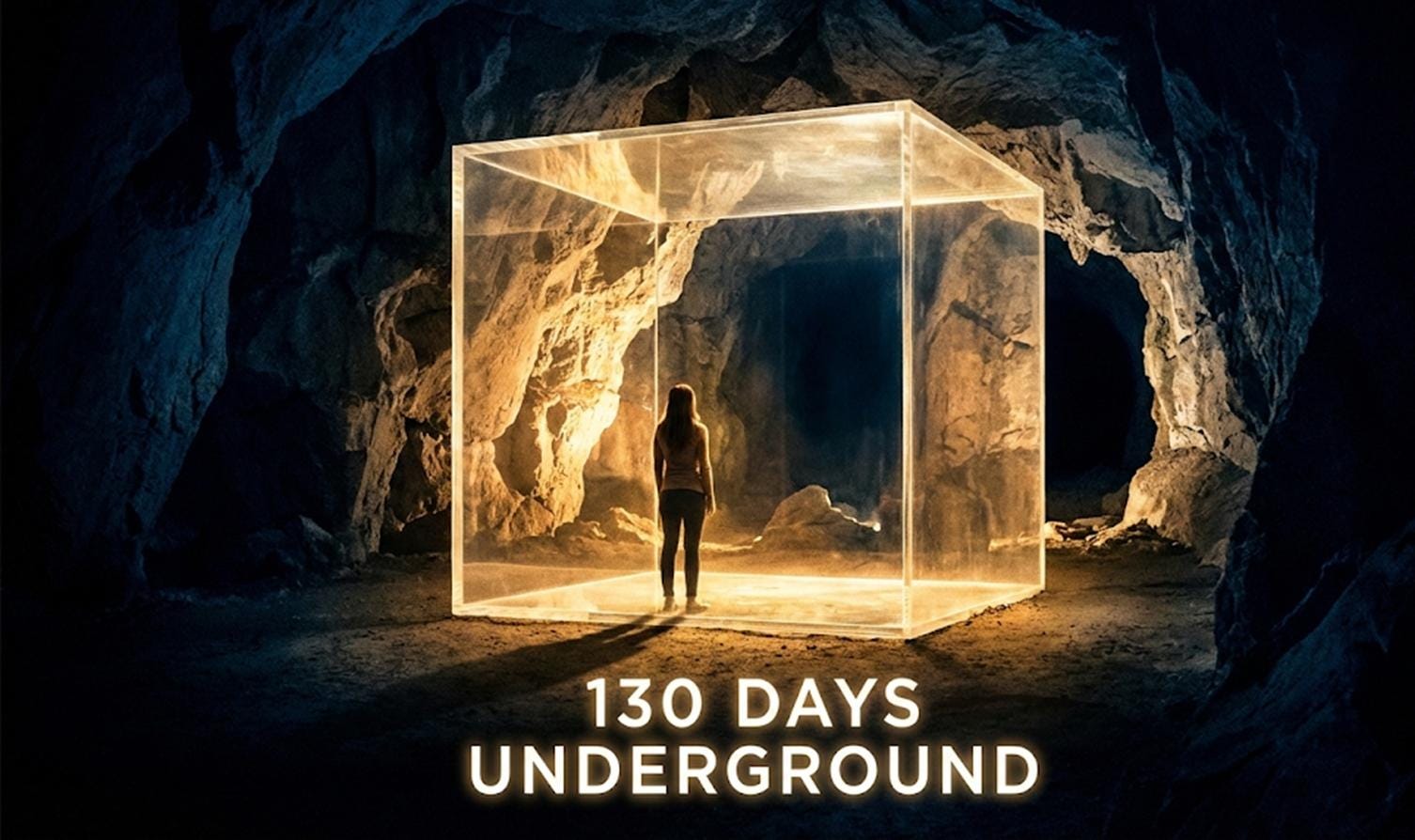
Stefania Follini is not, as one might half-jokingly suppose, of the Wiltshire Follinis, no, she is Italian, though her fame does not stem from her nationality, nor from her profession as an interior designer. In fact, she is not famous for anything she actively set out to achieve. Her notoriety stems from an experiment she undertook herself, an extraordinary descent underground for 130 days in 1989, a journey that led her deep into the heart of a cave rather than into the air or the sea. This was no ordinary cave: Lost Cave, a limestone formation thirty feet below the arid surface of the Chihuahuan Desert near Carlsbad, New Mexico. It was chosen less for its mystique than for its practicality, sitting conveniently within three miles of town and offering researchers access to electricity, water, and the occasional rattlesnake advisory. She holds the women’s world record for longest cave isolation, a distinction unlikely to have been bestowed by Norris McWhirter in person, though the image of him presenting the certificate with solemn gravitas, perhaps in a dry-cleaned safari suit, standing beside a cake bearing a hand-drawn cave entrance, is rather appealing. (The cake, incidentally, was real: a large confection delivered at her emergence, decorated with a cave-dwelling tableau, alongside half a $50 bill, the other half having been handed to her by Carlsbad’s Mayor Bob Forrest before descent, as part of a gentleman’s wager she wouldn’t see it through.)
The experiment was designed to investigate circadian rhythms, how the human body keeps time in the absence of external cues like daylight. Most people assume, reasonably enough, that in total darkness the internal clock settles into a rhythm of roughly twenty-three or twenty-four hours. Not so. In Follini’s case, her natural cycle first stretched to twenty-eight hours, then ballooned further to forty-eight, stretching awake periods to twenty or twenty-five hours at a stretch, followed by ten-hour sleeps, like a marathon runner pacing herself across a day that refused to end. This drift away from the standard solar day raises all manner of peculiar implications, not least for labor efficiency. One could easily imagine a particularly unscrupulous enterprise relocating its operations underground to extract longer workdays from its employees, although it’s worth noting that such a setup already resembles certain above-ground logistics hubs, where fluorescent lights hum through the night and the phrase “What time is it?” is met with a shrug and a glance at a delivery manifest. If a person’s natural day doubled, would their lunch break also double? Or would the union rep, yes, there is always a union rep, insist on proportionality? The logistics of scheduling become delightfully absurd when time itself is no longer anchored. Follini’s own body responded with textbook indifference to social convention: her menstrual cycle ceased entirely, her immune system dipped, calcium drained from her bones at a measurable rate, and she shed seventeen pounds on a diet heavy in beans and rice, depleting vitamin D with no sunlight to synthesise it, turning her pale as printer paper by emergence day.
Follini descended into the cave with no natural light, no clocks, no sunrise or sunset to mark the passage of hours. She was not, however, plunged into pitch-black despair, fumbling among stalactites and bat droppings. Instead, researchers had constructed for her a 20-by-12-foot acrylic glass room, essentially a transparent box placed within the cave, allowing her to see out into the surrounding darkness while remaining contained, like a specimen in an exhibit titled *Homo solitarius: Phase I*. Why acrylic glass? Presumably to simulate, in some rudimentary fashion, the kind of enclosed environment future astronauts might inhabit on extended missions, Mars-bound crews sealed in habitats where the only view is blackness punctuated by instrumentation, and the only sound is the low thrum of life support, or, in Follini’s case, the occasional rustle of a grasshopper or the soft *plink* of a guitar string. She was allowed to control the lighting herself, three floodlamps, switched at whim, but without any external reference, her sense of time dissolved like sugar in warm tea. One participant in the discussion admitted that, given the same scenario, they’d simply keep a clock running and switch the lights at conventional hours; but Follini wasn’t permitted that luxury. The computer terminal had no clock function, only a text interface for relaying messages to the researchers in the trailer above, and occasionally to NASA’s Johnson Space Center in Houston, where a team led by Dr. Jon DeFrance awaited her for post-exit EEG scans. And while the screen provided light, it was artificial, unmoored from solar cycles, contributing to the drift. The idea of mischief via terminal was floated: sending repeated messages like *“HELP , OH GOD THEY HAVE DONE IT”* just to unsettle her, though April Fools’ in 1989 was deemed perhaps too cruel, especially given that the cave’s temperature held steady at a cool 69 degrees, while outside approached 105, and rattlesnake season loomed like a deadline no one wished to meet. Her weight loss was significant, a direct consequence of her elongated days: fewer meals, longer intervals between them, each bite spaced like stations on a very slow railway. When the end finally came, her disbelief, *“Are you really serious?”*, was entirely understandable. She’d just got the place looking how she wanted it: she’d built a cardboard window with lace curtains framing a star-filled sky and a crescent moon; fashioned a beer keg, a loaf of bread, bottles of wine, a chess set, a top hat, and even a cat, presumably not *too* lifelike, lest Giuseppe and Nicoletta stage a coup. That choice transforms the experiment from an act of rugged survivalism into something more clinical and unsettling, a study in curated confinement, where interior design became a kind of psychological ballast.
She was not entirely alone. Her only companions were two friendly mice, Giuseppe and Nicoletta, distinctly Italian names for a study conducted in the arid scrublands of southeastern New Mexico, a landscape where the idea of an espresso bar was little more than a distant memory. Frogs and grasshoppers also shared the cave’s air, though their involvement appears to have been more accidental than contractual. In fact, NASA was involved in one way or another, alongside Pioneer Frontier Explorations and the Research Group of Ancona, raising the question of why an American space agency would recruit an Italian interior designer for a cave-based time-perception study. Perhaps they needed someone with an eye for spatial aesthetics to make the underground chamber more livable, or, more cynically, to do it for free, on the principle that if one must be buried alive for science, one might as well do it in good taste. One can picture the negotiation over pre-descent espresso: *“Now that you’ve settled in… while you’re down there, could you just zhoozh the place up a bit? A couple of throws, maybe some cardboard cutouts…”* She did, in fact, decorate the space with elaborate constructions from construction paper, though the transcript does not specify their subject, Bill Clinton remains a tantalising possibility (he was, after all, Governor of Arkansas at the time), though more likely they were generic figures meant to simulate human presence, à la *Home Alone* or *Bugsy Malone*, where cardboard stand-ins create the illusion of occupancy, and perhaps the faint hope of dialogue.
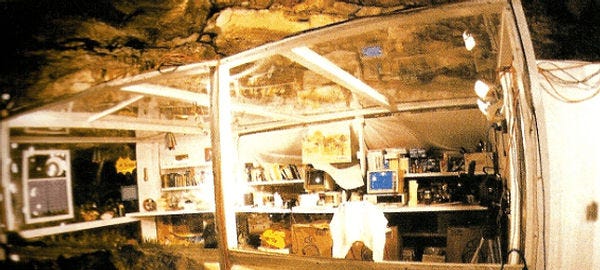
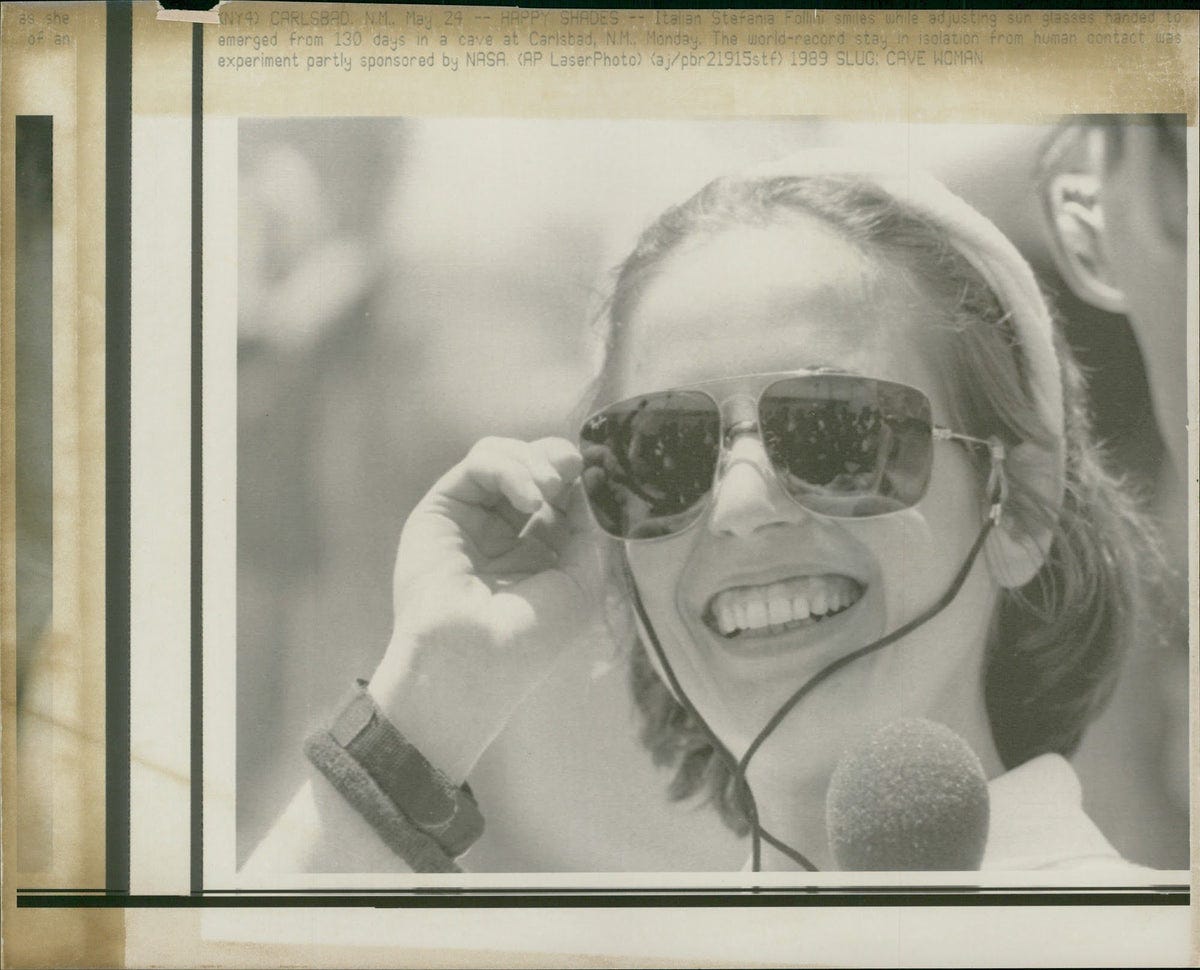
Beyond décor, her provisions included English primers (she emerged having picked up phrases like *“Wow, man!”* and *“I feel great”*), books, a guitar, of course a guitar, and a computer terminal, the sole means of communication with the outside world. This was 1989, so the terminal offered only text-based interaction, no video, no voice, just lines of characters flickering on a monochrome screen, like a telegram from the future. No clock function, naturally, that would defeat the purpose. She controlled the artificial lighting herself, unaware of when day gave way to night outside, and gradually her internal rhythms elongated, like taffy pulled too far. She entered the cave at 3 a.m. on January 13th, chosen, one suspects, for maximum psychological disorientation, and emerged on May 22nd, blinking into 97-degree heat, sunglasses layered over prescription lenses like a spy preparing for daylight. But when told it was time to come out, she reportedly responded, *“Are you really serious?”* Her sense of time had collapsed so thoroughly that she believed it was only mid-March, specifically March 14th or 15th, the date she offered when quizzed, having convinced herself just two months had passed. The discrepancy is staggering: over two months of actual time compressed into her subjective experience of barely two, like a cassette tape played at double speed and then rewound by memory alone.
She had descended at 3 a.m. She began her subterranean stay on January 13th, chosen without symbolism; the research team simply wanted her circadian baseline established before the first full subjective “day” began. The effects were nearly immediate: within weeks, her menstrual cycle ceased. Her sense of time didn’t just blur, it inverted, reversed, then reoriented itself in unpredictable loops, like a compass needle circling before settling on a false north. She missed little of the outside world, she later said, because “everything that was missing was replenished by what I had.” Fear and doubt surfaced, inevitably, but she countered them with a quiet mantra, “nothing lives forever, only the mountains and the earth”, a phrase repeated so often it became part of the cave’s ambient hum, alongside the rustle of cardboard and the occasional chirp of a grasshopper.
Her only light came from three floodlamps, switched at will, their glare bouncing off the acrylic walls, never soft, never golden, never fading like a sunset. She read, strummed, and practised tai chi, exercises that served as rituals to mark transitions in a world where dawn never arrived. From construction paper, she fashioned an entire theatre of normalcy: a window with lace curtains framing a hand-drawn starfield and crescent moon; a beer keg, bottles of wine, a loaf of bread, a chess set, a top hat, even a cat, crafted with enough care to suggest companionship, if not warmth. She talked to the mice, to the frogs, to the grasshoppers, “I was always right,” she said, laughing, and in return, they never argued, never interrupted, never asked her to turn the guitar down.
Her meals, spaced across 20- or 25-hour wakeful stretches, leaned heavily on beans and rice, simple, shelf-stable, calorically modest. Vitamin D depletion was inevitable; sunlight, after all, is not something one can simulate with floodlamps and goodwill. By emergence, she’d lost seventeen pounds, her muscle tone softened, calcium leached silently from bone, but doctors, reviewing her vitals, still called her condition “wonderful,” a testament less to robustness than to discipline. Blood and urine samples, hauled up in a canister on a string, revealed hormonal shifts: cortisol rhythms flattened, melatonin peaks smeared across subjective evening and morning alike. Her concentration deepened, the brain, unburdened by social noise, turning inward with monastic focus, but her immune markers told a quieter, more cautionary tale.
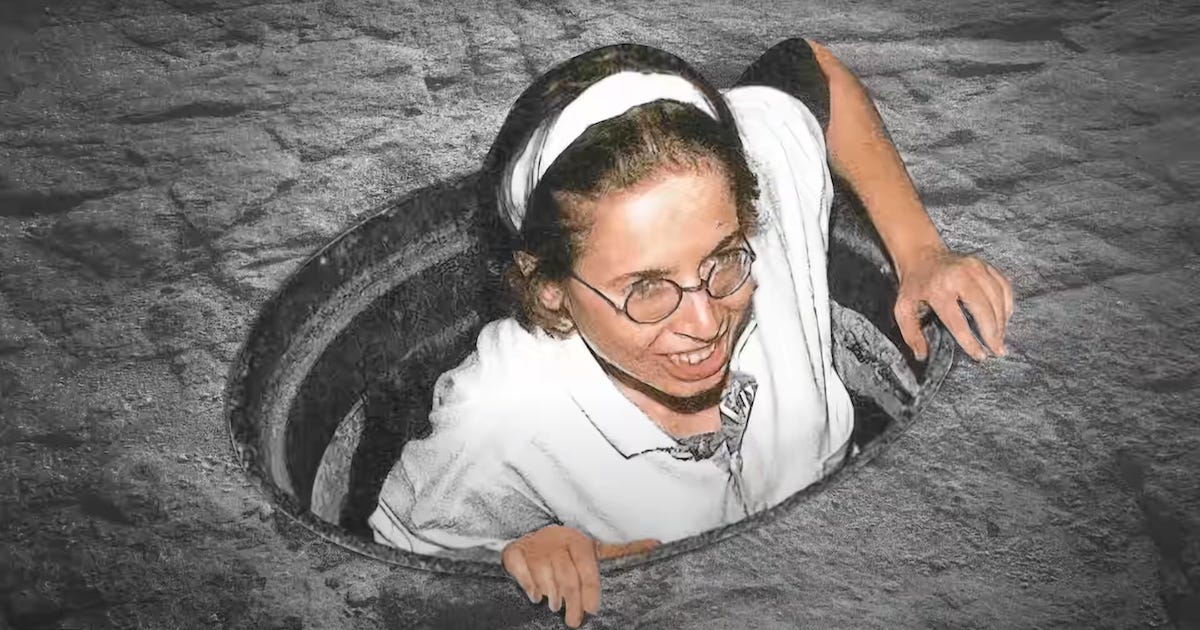
When told on Monday, May 21st, that her emergence was imminent, she hesitated, moved less by fear than by a quiet reluctance to leave. To her, it felt like “Monday morning when the alarm clock goes off”: an unwelcome intrusion into a world she’d painstakingly made coherent. She’d calculated the date as March 14th, give or take a day, two months, not four, her internal chronometer having slipped its gears without so much as a squeak. And when Maurizio Montalbini finally broke radio silence, his voice crackling over the intercom after 130 days of typed exchanges, her first reaction wasn’t awe or panic, but dry, disbelieving humour: “I didn’t think you would find me down here.” As if she’d been hiding. As if time herself had granted her asylum.
Above ground, a house trailer served as mission control, equipped with video monitors, microphones, and a line to Houston, and presiding over the operation, here’s where the story takes a conspiratorial turn, was Maurizio Montalbini, an Italian sociologist, caver, and, crucially, the man who held (and would later extend) the world record for underground isolation. Montalbini, it turns out, had already spent 210 days underground before Follini’s trial, and would go on to spend a full year from December 1992 to December 1993 in a cave near Pesaro, emerging convinced it was only June, a miscalculation so severe it suggests time, for him, had become a suggestion rather than a law. His immune defense system, according to one ominously vague report filed after that later ordeal, dropped from a level of 23 to 0, a statistic presented without units or context, the sort of number that haunts mathematics teachers in their sleep, like a final exam question with no answer key. Zero, after all, is rarely a good sign, even in modular arithmetic.
The coordination of Follini’s experiment by the very man who would later surpass her record invites speculation. Did he use her trial run to refine his own approach? Was he, in fact, biding his time, letting someone else test the waters, or rather, the limestone, before committing himself? One imagines him observing her descent, rubbing his hands together in the trailer, murmuring, *“Soon.”* And when, after 130 days, it came time to contact her and announce the experiment’s conclusion, what did he say? According to the transcript, the first human voice she heard, other than her own, delivered the line: *“Stefania, I am your God, talking to you.”* Whether this was Montalbini’s improvisation or a scripted flourish remains unclear, though the Chicago Tribune notes he later described the moment with dry irony, saying only, *“We are ready to get away from here.”* One can picture him rehearsing in the trailer the night before: *“What do I say? What do I say? Argh, I know! ‘This is your God talking to you!’”* Perhaps he even hired James Mason to dub the line for gravitas, though budgetary constraints likely limited casting to whoever was available and sufficiently dramatic before lunch.
Despite the ordeal, or perhaps because of its peculiar mundanity, Follini later dismissed concerns that her contribution to science had been traumatic. When asked, she called it *“a very simple thing.”* She took books with her. She had a guitar. One can only hope it was not the sort of guitar that invites impromptu renditions of *“Smoke On The Water”* on repeat, the kind of instrument that, in confined spaces like student housing or hypothetical Mars capsules, becomes a weapon of psychological warfare. (There is, after all, documented precedent: the fresher whose upstairs neighbour attempted the iconic riff, only to have the power cord yanked from the wall in mid-clunk, without a word exchanged.) One likes to imagine, instead, that Follini had something far more substantial down there, a full Fender stack, a Gibson SG, perhaps even a mirror hat, rocking out alone in her acrylic cell to “Master of Puppets” while stalactites trembled in sympathy, or perhaps while Giuseppe nibbled the strap and Nicoletta contributed backing harmonies at ultrasonic pitch.
The mice, Giuseppe and Nicoletta, were not the only non-human presences considered, cats, dogs, ducks, and moles were jokingly proposed as companions during pre-trial banter, though ants were immediately dismissed with laughter: *“I can’t take ants with me!”* Mice, however, made the cut, described in the original account as her only living companions, apart, of course, from the spectre of circadian drift and the occasional intrusive thought. She also had white spirit on hand, which provoked immediate alarm, *“White spirit?! ‘This is a far superior drink to meths!’”*, though it was almost certainly for paint-thinning her cardboard constellations, not for consumption. Her interior design instincts persisted underground: throws, cushions, tables, and something with big flappy cuffs were humorously imagined, though in reality, her décor consisted of cardboard cutouts and whatever morale-boosting items MDF and ingenuity could provide. Desert Island Discs was invoked less as a format and more as a mindset, a way of asking what could sustain you, psychologically, in utter isolation. The answer, apparently, was mice, cardboard, and a guitar. When asked what she’d taken down with her, food was the obvious reply, but the question was about companions, living, inanimate, or conceptual. Skateboard was suggested, though cave floors offer little for cruising. Fifteen pounds of LSD was, naturally, ruled out, though “herbal substances” lingered as a tantalising ambiguity. (She *did* practise tai chi and judo, less for combat than for preserving muscle tone against the slow creep of atrophy.) The cave, for all its scientific austerity, became, briefly, a stage set, designed, inhabited, and ultimately outlasted.
Follini’s experiment coordinator, Maurizio Montalbini, heard a human voice other than his own for the first time after his year underground, though whether he introduced himself as God remains unconfirmed. As for Follini, post-emergence life resumed with quiet pragmatism: a week of tests in New Mexico and Houston, EEGs with electrodes mapping the brain’s problem-solving circuits in real time, bone-density scans, immune assays, coordination drills. Doctors pronounced her in “wonderful” condition, considering she’d just spent four months in a lightless box with two rodents and a dream of stars pasted on the wall. She later remarked, *“The smell of human beings is very beautiful.”* And when asked if she’d do it again, she said, *“Sure.”* For Stefania Follini, one suspects, time was never a river at all but a room, one she could enter, rearrange, and leave whenever she pleased.
Comments
Post a Comment