The Physics of Mars Bars as Reentry Weapons
The Hidden Corporate War Fought With Maltesers and Mars Bars
The flag of Mars presents a curious case, though not the planetary kind. No, this is about the chocolate bar, the one with the slogan "A Mars a day helps you work, rest, and play," which, upon reflection, sounds less like a nutritional recommendation and more like the terms of a suspiciously generous employment contract. The flag in question isn't flown over any nation-state, but it does hover, metaphorically, above a corporate battlefield of profound confectionery consequence, part of a sprawling, sticky, and frankly underreported conflict known, in hushed tones, as the Chocolate Wars , a decades-long struggle for market dominance fought with marketing budgets and shelf-space strategies.
It all begins, as these things often do, with misplaced heraldry. Someone suggests the flag of Mars, and immediately there's confusion: is this about the planet? The bar? The people who make Galaxy chocolate? Yes, totally, yes. It's a bit like a Japanese flag, only instead of a red sun, it's a big Malteser in the middle. Surely that's the Maltese flag? Ohhh, you! He got me bang to rights! Meanwhile, across the river, strategically positioned, one assumes, to deny easy access to the cocoa supply lines, flies the flag of Cadbury's. Purple, of course. In this allegorical battle, "We march beneath our purple banner to GLORY!" And they do. Loading cannons, again, with Maltesers. Just as grapeshot. "This is the most delicious battle ev, AAUGH!" Aaah! "Still pretty good..." Honeycomb and chocolate, propelled at velocity, striking unprotected eyes. Goggles, obviously, is the first consideration. I think we can all agree.

In the timeline of this corporate conflict, Hershey's didn't become a major global force until around the mid-20th century. Ohhh! Yes! And it'll just be terrible anyway. That's less a military assessment and more of a comment on their chocolate. Founded by Milton S. Hershey in 1894 after he saw chocolate-making machines at the 1893 World's Columbian Exposition in Chicago, the company initially focused on caramels before Hershey declared, "Caramels are just a fad, but chocolate is a permanent thing." Little did he know his American chocolate would develop that distinctive tang, due to butyric acid, a compound also found in Parmesan cheese and vomit, that would become its trademark for generations.. Hershey's even supplied the chocolate ration for American troops during WWII, though rumor has it many GIs preferred trading them for Cadbury bars from British allies.
Cadbury's, ever the innovators since 1824, send in the 1st Mounted Freddos as the first wave, or at least, they would have, if their mascots were soldiers. In reality, they deployed aggressive pricing. though they'd probably have deployed the Taz's if they'd had the nerve. Could you imagine the devastation? That's why Freddos went up to 20p. There was a shortage after the battle of consumer goodwill and affordable treats. Right. Massacred. Massacred. Caramel guts sprayed all over the place! "Leave me! Leave me! Go on yourself!" "Aaargh!"
The Cadbury arsenal includes the legendary Creme Egg, introduced in 1963 by Fry's before being renamed Cadbury's Creme Egg in 1971, a tactical masterpiece containing sweet white and yellow fondant filling designed to mimic a soft-boiled egg. At the Bournville factory in Birmingham, these weapons of mass confection are manufactured at a staggering rate of 1.5 million per day. In 2015, Cadbury commanders made a controversial strategic decision to replace their Dairy Milk chocolate with a "standard cocoa mix chocolate" for the Creme Egg shell, triggering a catastrophic loss of over £6 million in sales as loyal troops abandoned their posts in disgust. The battlefield was littered with empty wrappers and broken dreams.
The imagery expands: Mars bars reimagined as ordnance rather than rations. Like the Soviet Katyusha rocket launchers of World War II, a relentless, multi-pronged marketing assault. Though truth be told, the Mars company itself was born from a similar wartime innovation. In 1941, Forrest Mars partnered with Bruce Murrie, son of Hershey's president, to create M&M's, those tiny soldiers with their hard sugar shells designed to withstand tropical conditions. The "M" in M&M stands for both Mars and Murrie, though Murrie sold his stake in 1948, leaving Mars to become one of Hershey's fiercest competitors. The slogan "the milk chocolate that melts in your mouth, not in your hand" became their battle cry in 1949. These candy-coated warriors were initially deployed exclusively to military personnel during WWII, a clever supply chain maneuver that built brand loyalty among returning soldiers.
The Swiss, naturally, try to sit it out. "Not happening!" Nope, nope. Neutrality is a fine principle until someone mistakes your Toblerone for a bunker-buster key competitor. Curly Wurlys, with their serpentine flexibility, prove unexpectedly useful as trenching ladders a long-lasting value option, grippy, resilient, and nutritionally sustaining mid-climb. Revels, with their random flavor distribution, serve as grenades a perfect analogy for a risky purchase: pull the pin, hurl it, and pray you don't get the dreaded orange one mid-assault. Psychological warfare, frankly.
Do you remember the Cadbury's Caramel Rabbit? Yes, I do. She'd be Florence Nightingale, calm under fire, soothing the wounded with gentle pats and slow, deliberate unwrapping. Though some of the troops, admittedly, had other ideas. "I was thinking she was the cheesecake for the troops." "Oh crikey. Steady lad!" And the old ENSA shows, Be still! "Hi boys... I'll just undo the wrapper slightly..." Cheers. "Show us your gooey centre!" Groans. That's the greatest laugh I've ever heard! Don't make him self-conscious of his laugh. He's got to keep it going. No! That would be even worse.
Horribly, the laughter gave way to darker thoughts: one-legged Freddos, hobbling back from the front. "Yeah, lost the leg back in '15 in the Chocolate Wars." "They did melt a new one onto me, but it's not the same." It's a leg from a Santa. Slightly peppermint-scented, prone to seasonal melting. And then the absurd vision of Taz's, those hyperactive, spiraling vortexes of caramel and biscuit, riding Lindt bunnies into battle. No, Lindt's German, isn't it. It's not Swiss. I thought, yeah, Swiss neutrality, but yeah. "Chaaarge!"
Christ, have I told you about this, when I went to the Lindt factory in Germany? Hello! Did you find the weapons stockpile or something? No, sadly it's even better than that. Because you go to the Cadbury's tour, and it's pretty much on the site of the real factory, you're just one room over from the actual production line. Well, Lindt have got this little one that's on an island in one of the rivers, I forget which German city it is, I do apologize. And so you go on through, and they've got the fake little factory bit, and then there's this big display board about Mr. Lindt. Okay. Saying, "da da da... Mr. Lindt started this company in blah blah blah blah in da da da..." Then the war starts: "Sadly, Mr. Lindt was tragically killed in 1918." So it's like, oh, so he went to war, you know... it was a bombing raid or whatever... No! Mr. Lindt, having already sold his factory and retired to a life of quiet Swiss luxury, escaped the Chocolate Wars entirely—he died peacefully in 1909, presumably from an excess of his own silky chocolate rather than an exploding vat of it.. Ohhh! And covered him in delicious goo! , If you're gonna go...! , Death by chocolate! And if someone didn't say that at the time... "Eh? I know it's a little bit soon but, er..." "Death by chocolate? Eh?"
You see, Mr. Lindt’s fate, while tragic, was at least artisanal. Contrast that with the Bournville front lines: 1.5 million Creme Eggs a day, each shell formed in chilled steel moulds, white fondant piped in, then a precise dollop of paprika-tinted yolk, halves snapped shut before the chocolate sets. A ballet of calibrated pumps and pneumatic presses. And then, the betrayal. January 2015. Cadbury High Command, under Mondelēz oversight, swapped the Dairy Milk shell for a “standard cocoa mix.” A cheaper shell. A coward’s shell. The troops noticed instantly. Sales bled £6 million, then $12 million globally, like fondant from a cracked egg. New Zealanders, already reeling from the 2009 import switch (their locally made eggs had runnier goo, allegedly), staged a full mutiny. Even the foil changed: pink and blue banished, purple promoted. The chick mascot vanished. A silent retreat. The battlefield wasn’t just sticky, it was grieving. One corporal, interviewed mid-rout, whispered hoarsely into a wrapper: “It’s not the same. The snap… the melt… the goo.” He didn’t need to say more. I can hear the damn muted trombone... Womp womp womp... "No, it was horrifically heated caramel, Vicar." "There's a reason the casket is closed." "But, er... Still good!" "In death, as in life... Mr. Lindt was delicious." "All right [??], he may now be just the human equivalent of a Daim bar..." Soft on the outside, crunchy on the inside, Mr. Lindt!
Meanwhile, the Hershey's forces were amassing across the Atlantic. After acquiring the rights to manufacture Cadbury-branded products in the United States in 1988 (except gum and mints), Hershey's attempted to invade British shores with their own Creme Eggs, only to face fierce resistance when they tried to decrease the size of American market eggs while claiming otherwise on their official website. In 2015, Hershey's launched a legal offensive against British importers to halt imports of authentic British Cadbury chocolate, a move that reportedly angered consumers and sparked accusations of corporate overreach. A potential merger between Mondelēz and Hershey's was considered but abandoned in 2016 after Hershey's turned down a $23 billion cash-and-stock bid. The failed negotiations were like watching two chocolate giants dance awkwardly at a corporate prom, everyone knew they should probably get together, but neither wanted to lead.
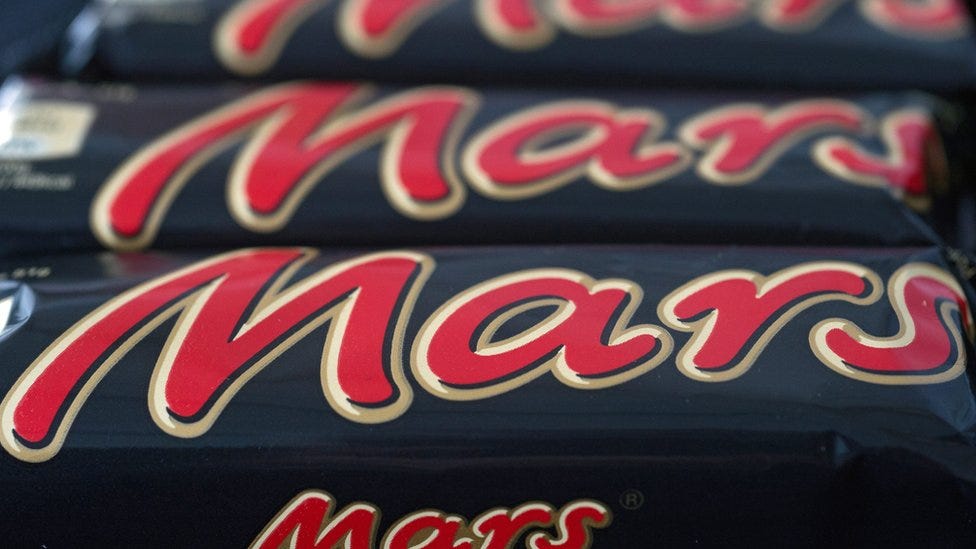
Back to Mars. The bar, not the planet, though the planet's name does lend a certain gravitas to the branding, doesn't it? Red planet, red wrapper (well, mostly red), and an implicit promise of sustenance in hostile environments. Astronauts, colonists, office workers facing 3 p.m. slumps, they're all, in their way, surviving on alien terrain. The Mars bar, with its twin layers of nougat and caramel enrobed in milk chocolate, is built for endurance. It doesn't melt too quickly. It doesn't crumble too easily. It holds together under pressure, unlike, say, a Double Decker, which is basically a structural engineer's nightmare wrapped in foil.
Which brings us to tactics. Could a Mars bar survive reentry? As a weapon? What if it were in a wrapper? What, like Eminem? Yeah. So what you're espousing is, putting a Mars bar in a round that will burn up perfectly through reentry, leaving you with a solid, slightly singed bar, which will then refreeze in the upper atmosphere, slowly defrost slightly, and then... Well, it’s hardly going to level a city. Still, the psychological impact? Immense. "Ooh! Mars bar!" "Nuclear weapons? F* that. We can take you down with a Mars bar."** Gentlemen, I have an announcement... I have a Yorkie strategically positioned over the major centres of the world. Actually, yeah, that is your weapon of choice, unless you can afford some of that posh dark chocolate. But I don't think the Swiss'd sell it to you. So yeah, basically the weapon of choice for Britain in the space chocolate arms race has to be the Yorkie.
You see, Red and Yellow weren’t just mascots, they were veterans. Their debut came not in peacetime, but mid-campaign, during the infamous “Blue Mutiny” of 1995, when the Tan M&M, loyal, dependable, slightly beige, was summarily retired to make room for the upstart Blue, a cool, saxophone-playing interloper voiced by Robb Pruitt. The betrayal was absolute. Tan hadn’t even melted in service; it was cashiered purely on aesthetics, a casualty of the Great Color Vote, a plebiscite held under the dubious slogan, “Pick the New M,” wherein 10 million civilians weighed in like conscripts choosing their next general. Blue prevailed through numbers rather than valor, winning by a 54% margin. Tan vanished soon after, its service record redacted, its image scrubbed from all official portraits. A quiet dishonourable discharge. Meanwhile, Orange, the neurotic one, perpetually anxious about structural integrity, was promoted from reserve status when Crispy entered the theatre, only to be reassigned again in 2010 when Pretzel arrived, a wiry, salt-laced infantryman who brought his own support unit: the unnervingly calm Pretzel Guy, whose sole function was to murmur tactical reassurances like, “You want the crunch inside you.” Madness.
And let’s not forget the ill-fated Dulce de Leche Offensive of 2001, targeted at Hispanic strongholds in California and Texas, a stealth operation that collapsed within two years when locals, bless them, simply preferred the classic ordnance. A textbook case of cultural misfire: you don’t win hearts and minds with caramel proxies when the home front’s already well-supplied with dulce real. Even the vaunted “Mega” deployment, those 65% larger, ogre-hued units launched alongside Shrek 2, proved unsustainable, their bulk rendering them logistically unwieldy. Too big for standard-issue wrappers. Too conspicuous for covert ops.
Then there’s the matter of voice. Red’s cynicism, originally Jon Lovitz’s, now Billy West’s, was forged in the crucible of the “Chocolate Pool” ad of 1954, where he and Yellow first dove into liquid confection like commandos breaching a dam. Yellow, voiced first by John Goodman, then J.K. Simmons, remained stubbornly upbeat despite repeated battlefield trauma: being mistaken for a lemon drop, trapped in vending machines, once nearly melted during a desert drill in Nevada. And Green, ah, Green, whose seductive purr (Cree Summer, mostly) leaned hard into the 1970s urban legend that her shell contained aphrodisiac properties. A psyop so successful, it spawned the all-green Valentine’s assault of 2008, a campaign so potent, it required mandatory goggles and chaperones.
Which brings us, inevitably, to Ms. Brown, Vanessa Williams’ cool, calculating Chief Chocolate Officer, entered the scene in 2012 as part of a sweeping reorganization rather than a reinforcement. A sign the war was becoming… bureaucratic. More boardroom, less bunker. Still armed, still wrapped, but now filing after-action reports in triplicate and auditing caramel viscosity compliance. Even Purple, introduced in 2022 and voiced by Amber Ruffin, made her arrival through melody, a ballad titled “I’m Just Gonna Be Me.”” A terrifying development. When your artillery starts singing about self-actualisation, you know the rules of engagement have irrevocably shifted.
Still, Mars holds its own. In 1995, Mars introduced the computer-animated characters Red and Yellow in their advertising campaigns, creating personalities for the previously anonymous candy soldiers. Their Christmas commercial featuring these characters running into Santa Claus became one of their most enduring and iconic television advertisements, replayed every December like a chocolatey version of "It's a Wonderful Life." The company even sponsored NASCAR drivers like Kyle Busch with colorful paint schemes covered in M&M characters, a brilliant tactical maneuver that transformed stock cars into mobile confectionery billboards traveling at 200 mph. Dense, reliable, no-nonsense. In the grand confectionery hierarchy, it doesn't preen like Galaxy, nor does it rely on novelty like the seasonal Twix variants. It simply is. And when the Freddos have been massacred by price inflation, the Taz's have spiraled out of control production, and the Caramel Rabbit has retired to a quiet life writing memoirs, it's the Mars bar that remains, wrapped, ready, waiting in the ration pack. Eat nougaty death, ye Martian bastards! A testament to enduring brand power. They've suffered enough.
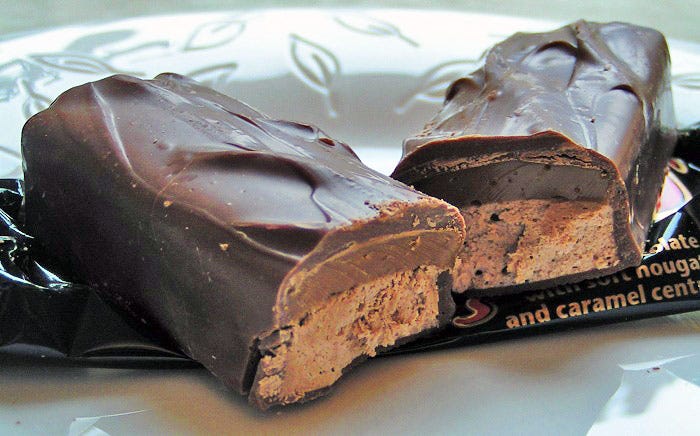
Meanwhile, across the river, yes, again, the Cadbury forces regroup. Just loading cannons, again with Maltesers. Just as grapeshot. 'This is the most delicious battle ev, AAUGH!' Aaah! 'Still pretty good...' Honeycomb and chocolate in the eye at velocity! Goggles, obviously, is the first consideration, I think we can all agree. In their arsenal, the Screme Egg variant stands ready for Halloween deployments, identical to regular Creme Eggs but with a green yolk instead of yellow, perfect for terrifying small children and dentists alike. The Creme Egg Twisted bar was a specialized unit, now decommissioned from active service, though remembered fondly by veterans of the conflict. "We will not be assimilated!" they cry, even as their numbers dwindle. Hershey's won't join until 1941. Ohhh! Yes! And it'll just be terrible anyway. That's more of a comment on their chocolate. Cadbury's sending in the 1st Mounted Freddos, as the first... No, they'd send in Taz's! Could you imagine the devastation? That's why Freddos went up to 20p. There was a shortage after the battle. Right. Massacred. Massacred. Caramel guts sprayed all over the place! 'Leave me! Leave me! Go on yourself!' 'Aaargh!' I've just got the thought of Mars... like they were multiple rocket-launchers in World War II, a Mars bar, like that. Thump! Thump! Thump! Each launcher firing a salvo of chocolatey projectiles that arc gracefully across no-man's-land before burying themselves in enemy territory, where they're immediately consumed by traitorous taste buds switching allegiances in mid-battle. The warfare may lack elegance, yet it remains undeniably effective. "Melts in your mouth, not in your hand", the ultimate battle cry of a confection built for combat zones where regular chocolate would surrender to the heat. God save the chocolate queen.
Comments
Post a Comment